

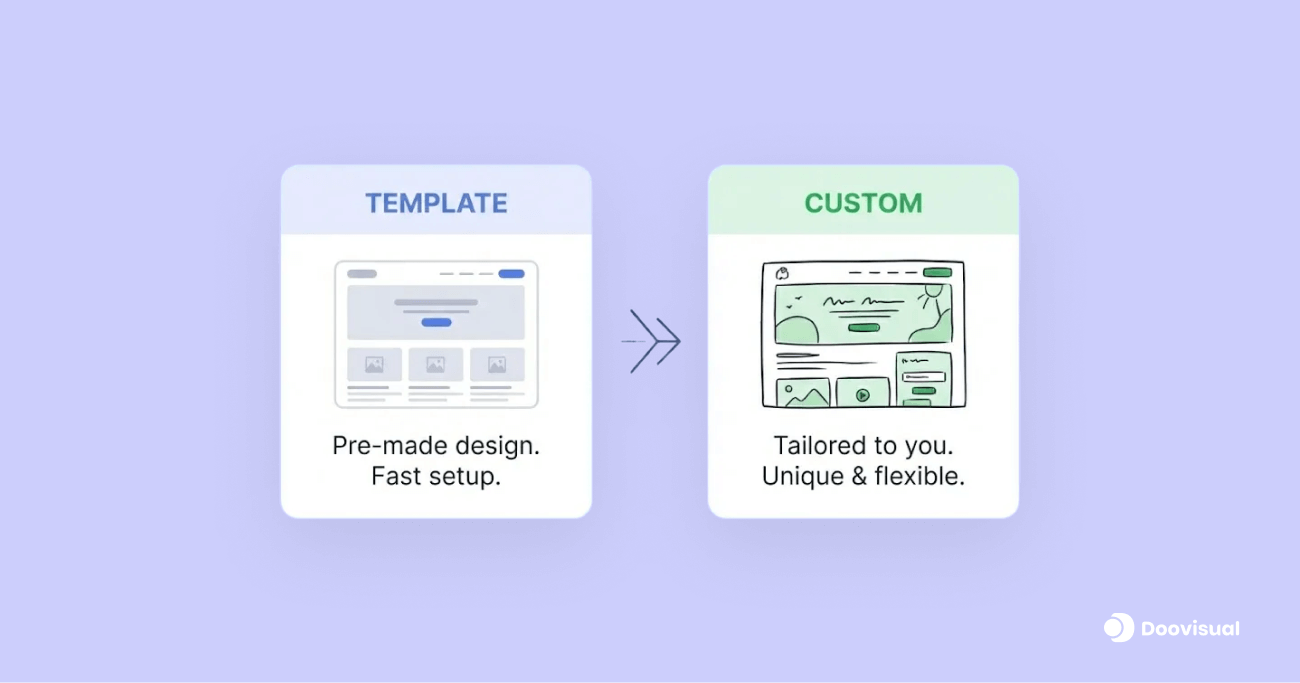
Website templates have never been more accessible. In 2026, a startup can launch a decent-looking site in a weekend using Webflow templates, Shopify themes, or WordPress builders. For early momentum, that accessibility is valuable.
The problem is not that templates exist. The problem is when startups outgrow them and fail to recognize it.
After years of designing websites for SaaS startups, early-stage companies, and growth teams, one pattern repeats consistently: templates are optimized for speed, not for differentiation, conversion, or long-term growth. At some point, that trade-off starts costing more than it saves.
This article explains why custom websites matter for startups, when templates stop working, and how founders can think about website decisions as a strategic growth lever rather than a cosmetic task.
Why Templates Feel Like the Right Choice Early On
Templates are attractive for good reasons.
They are fast to deploy, inexpensive, and require minimal decision-making. For founders juggling product development, hiring, fundraising, and go-to-market, templates reduce friction. They provide structure when clarity is still forming.
From a UX standpoint, templates work best when:
- The product is still being validated
- Messaging is unstable
- Traffic is low
- Conversion optimization is not yet critical
In this phase, the website’s primary role is to exist, not to perform.
The danger is that templates create a false sense of completion. A startup launches a site, traffic grows, ads run, and suddenly the website becomes the primary interface between the business and its customers. At that point, a tool designed for speed becomes a constraint.
The Hidden Cost of “Good Enough” Website Design
Most template-based websites are not broken. They are inefficient.
From analytics reviews across startups, template sites often show:
- High bounce rates
- Low engagement time
- Conversion rates below industry benchmarks
These issues are rarely caused by poor products. They stem from websites that do not align with how users actually think, browse, and decide.
Templates are built for generic audiences. They assume:
- Broad use cases
- Standard user journeys
- Minimal differentiation
Startups, by definition, do not operate in generic contexts. They are trying to:
- Explain something new
- Earn trust without brand recognition
- Convince users to switch from existing solutions
Generic design fails in non-generic situations.
Why Custom Websites Change How Users Perceive Startups
Perception matters more than founders often admit.
Users make subconscious judgments about credibility within seconds. Research consistently shows that design quality strongly influences perceived trustworthiness, especially for unfamiliar brands.
Template-based websites tend to:
- Look familiar in a way that signals “early”
- Blend into a sea of similar-looking startups
- Struggle to communicate unique value
A custom website allows design decisions to be made around:
- Your specific audience
- Your positioning
- Your product’s strengths
This doesn’t mean flashy visuals. It means intentional structure, hierarchy, and narrative.
When users feel that a website was designed for them, not assembled from pre-made parts, trust increases. Trust reduces friction. Reduced friction improves conversion.
Templates vs Custom UX: Where the Difference Actually Shows
The real difference between templates and custom websites is not aesthetic. It’s control over UX decisions.
Templates lock you into:
- Fixed layout patterns
- Predefined content hierarchies
- Limited interaction models
As a result, important UX questions often go unanswered:
- What should users see first?
- What objections need addressing early?
- How should the site adapt to different user intents?
Custom websites start from these questions instead of forcing answers into pre-existing structures.
From experience, conversion improvements rarely come from visual polish alone. They come from rethinking:
- Page flow
- Information prioritization
- Contextual calls to action
Templates make these changes difficult. Custom design makes them central.
How Templates Limit Growth as Startups Scale
Growth exposes weaknesses.
As traffic increases, templates begin to show friction in areas that matter:
- Navigation becomes cluttered
- Messaging becomes diluted
- UX compromises accumulate
Startups often respond by layering fixes on top of templates—custom code snippets, third-party plugins, workaround layouts. Over time, the site becomes harder to maintain and slower to evolve.
This is where opportunity cost becomes real.
Teams hesitate to change their website because:
- Changes break layouts
- Updates require workarounds
- Design debt accumulates
A website that should support growth becomes a bottleneck.
Custom websites, when designed properly, evolve more easily. They are built with scalability in mind—not just technical scalability, but UX scalability.
Conversion Is Where Templates Quietly Fail
Conversion optimization is rarely a priority when a startup launches. It becomes critical once acquisition costs rise.
Industry benchmarks show that small improvements in conversion rates can outperform increases in traffic. Yet template-based sites often struggle to improve conversions because the underlying UX structure cannot be adapted meaningfully.
Common conversion blockers in template sites include:
- Weak above-the-fold messaging
- Poor alignment between ads and landing pages
- Generic calls to action
- Inflexible page structures
Custom websites allow startups to design pages around specific conversion goals, not generic templates.
This is where experienced design partners like Doovisual typically step in—helping startups translate growth goals into UX decisions rather than surface-level redesigns.
Custom Websites Support Brand Before Marketing Does
Branding is not just logos and colors. It is how consistently a startup presents itself across touchpoints.
Template-based sites often struggle with brand expression because:
- Design systems are generic
- Typography and spacing feel borrowed
- Visual language lacks coherence
A custom website allows brand decisions to influence:
- Layout rhythm
- Interaction patterns
- Content presentation
This matters because users interact with websites more than logos. A website is often the first and most frequent brand experience.
Strong brands are not louder. They are clearer.
Where Startups Usually Delay Custom Design Too Long
One of the most common mistakes is waiting until growth problems are visible.
Founders often say:
“We’ll invest in a custom website once we’re bigger.”
In reality, many growth problems—poor conversion, unclear messaging, weak differentiation—are caused by the website itself.
Custom design does not require enterprise budgets. It requires clarity about goals and users. When done at the right time, it prevents expensive redesigns later.
How Template Limitations Change at Each Startup Stage
One of the biggest misconceptions is that templates are either “good” or “bad.” In reality, their usefulness changes dramatically as a startup evolves.
Early Stage: Templates Hide Problems
At the early stage, templates do something dangerous: they hide clarity issues.
When traffic is low and feedback is sparse, it’s easy to assume that a website is doing its job simply because it exists. Templates provide structure before founders truly understand:
- who their best users are,
- which message resonates,
- what objections matter most.
At this stage, templates don’t hurt much—but they also don’t help you learn deeply. The danger is mistaking silence for success.
Growth Stage: Templates Start Blocking Momentum
Once acquisition channels turn on, templates begin to show real cracks.
Paid traffic amplifies UX flaws. Messaging mismatches become expensive. Small conversion inefficiencies scale into large revenue losses.
At this stage, founders often feel something is “off” but can’t pinpoint it. Metrics show traffic increasing, but conversion rates stay flat. Engagement drops. Sales cycles feel longer than expected.
In most cases, the problem is not marketing. It’s that the website:
- does not adapt to different user intents,
- treats all visitors the same,
- forces a generic narrative on diverse audiences.
Templates struggle here because they are not designed for nuanced storytelling or intent-based UX. Custom websites are.
Scaling Stage: Templates Become Technical Debt
At scale, templates stop being a design choice and become design debt.
Teams start layering:
- custom scripts,
- third-party tools,
- hacked layouts,
- inconsistent sections.
Over time, the website becomes fragile. Changes break things. Performance degrades. Design consistency erodes.
Ironically, the original reason for choosing a template—speed—disappears. Updates take longer. Risk increases. Teams avoid touching the site unless absolutely necessary.
At this point, redesigning from a template to a custom system is not just a UX improvement. It’s a reset.
The Real Cost of Templates vs Custom Websites
Founders often underestimate cost because they only look at initial build price.
Templates are cheaper upfront. That’s true. But websites don’t exist in a vacuum. They evolve.
The real cost shows up in:
- lost conversions,
- slower iteration,
- delayed learning,
- missed positioning opportunities.
A template that costs little but suppresses conversion efficiency is far more expensive than a custom website that enables growth.
From experience across SaaS and startup websites, a modest conversion improvement—sometimes as little as 0.3–0.7%—often pays back the cost of custom design within months once traffic is meaningful.
Cost should be measured against what the website enables, not what it costs to launch.
Why Custom Websites Improve Decision-Making, Not Just Design
One of the most underrated benefits of custom websites is how they force strategic clarity.
Templates encourage filling in placeholders. Custom design forces teams to answer questions:
- What is the primary action we want users to take?
- What objections matter most at each stage?
- What information belongs above the fold—and what doesn’t?
These questions are uncomfortable. That’s why templates feel easier.
But startups that invest in custom websites often find that the design process clarifies:
- positioning,
- messaging,
- product-market alignment.
The website becomes a reflection of thinking, not just branding.
This is why experienced teams treat website design as a strategic exercise, not a cosmetic one.
The UX Debt Templates Create (And Why It’s Hard to See Early)
UX debt accumulates quietly.
Unlike bugs, UX debt doesn’t crash systems. It leaks value slowly:
- users hesitate instead of converting,
- confusion replaces confidence,
- trust erodes without obvious failure.
Templates accelerate UX debt because they lock early assumptions into structure. As the business evolves, those assumptions become outdated—but the structure remains.
Custom websites are not immune to UX debt, but they are easier to evolve because they are designed around intent rather than constraints.
From a senior UX perspective, debt that slows learning is more dangerous than debt that slows code.
Custom Websites and Brand Credibility in Competitive Markets
As markets mature, differentiation becomes harder.
When competitors use similar templates, similar layouts, and similar messaging patterns, users rely on subtle cues to decide who feels credible.
Custom websites allow startups to:
- control narrative flow,
- highlight unique strengths,
- create moments of clarity rather than noise.
This matters especially in SaaS, B2B, and high-consideration products where trust is earned before demos, not after.
A website that feels intentional communicates seriousness. One that feels assembled communicates risk.
That perception influences:
- demo requests,
- partnership conversations,
- even investor confidence.
When Custom Websites Are a Strategic Advantage (Not a Luxury)
Custom websites are not about looking expensive. They are about removing friction between intent and action.
They become a strategic advantage when:
- acquisition costs rise and efficiency matters,
- multiple user segments need different messaging,
- sales and marketing alignment becomes critical,
- brand credibility affects deal size or cycle length.
This is where agencies like Doovisual typically get involved—not to redesign for aesthetics, but to help startups translate growth goals into UX structure that scales.
Why “We’ll Redesign Later” Often Costs More
Many founders delay custom design because they believe they’re saving money.
In practice, delaying often leads to:
- multiple partial redesigns,
- inconsistent fixes,
- wasted marketing spend on inefficient pages.
Redesigning under pressure is always more expensive than designing intentionally.
The most successful teams don’t wait until things break. They redesign when signals appear—not when problems become unavoidable.
Real Startup Scenarios Where Templates Actively Hurt Growth
By the time startups feel the pain of templates, the damage is usually already happening. The signals are subtle at first, but they compound quickly.
Scenario 1: Paid Traffic Starts Scaling, Conversions Don’t
This is one of the most common red flags.
A startup launches paid acquisition—Google Ads, LinkedIn, Meta. Traffic increases. Spend goes up. Revenue does not scale proportionally. Conversion rates stagnate or decline.
In these cases, the website is often optimized for generic visitors, not intent-driven users. Templates force all traffic through the same narrative, regardless of where users came from or what problem they are trying to solve.
Custom websites allow teams to:
- Align landing page structure with specific ad intent
- Control narrative sequencing more precisely
- Emphasize different value propositions for different audiences
Without that flexibility, marketing efficiency plateaus. No amount of ad optimization fixes a UX bottleneck.
Scenario 2: The Product Is Strong, But Trust Is Weak
Many startups underestimate how much trust their website must earn—especially in B2B, SaaS, and high-consideration products.
Template-based websites often fail to communicate credibility because they:
- Look familiar in a way that signals “early”
- Rely on generic social proof placements
- Lack narrative depth
Users may understand what the product does, but still hesitate to engage. This shows up as:
- Fewer demo requests
- Longer sales cycles
- Lower-quality leads
Custom websites allow startups to intentionally design trust-building moments—through structure, sequencing, and emphasis—rather than hoping generic patterns will do the job.
Scenario 3: Multiple Audiences, One Generic Experience
As startups grow, their audience fragments.
Founders, operators, technical buyers, and decision-makers often visit the same website—but for different reasons. Templates struggle here because they assume a single user journey.
Custom UX design makes it possible to:
- Prioritize different entry points
- Adjust content hierarchy by intent
- Reduce friction for diverse audiences
When every visitor sees the same message, many feel like the site “isn’t for them.” That quiet mismatch costs opportunities long before it’s obvious in analytics.
The Long-Term Risk: Design That Can’t Evolve
Perhaps the most damaging impact of templates is how they discourage change.
Over time, teams become reluctant to touch their website because:
- Layouts are fragile
- Changes break responsiveness
- Workarounds pile up
The website becomes something to avoid, not improve.
This is the opposite of what a startup website should be. Your website should be one of your most flexible growth tools—not a static artifact frozen in early assumptions.
Custom websites, when built with a proper design system and UX foundation, are easier to evolve. They adapt as your understanding of users deepens.
Why Custom Websites Improve Strategic Thinking
There’s an overlooked benefit to custom websites that has nothing to do with visuals.
They force teams to think.
Templates allow teams to postpone decisions by filling placeholders. Custom design requires answering questions about:
- What matters most to users
- What to say first, and what to leave out
- What action truly matters
This clarity often ripples outward—improving sales messaging, onboarding flows, and even product decisions.
From a senior UX perspective, the website often becomes the clearest articulation of a startup’s thinking. When that thinking is borrowed, the product feels borrowed too.
A Practical Decision Framework for Founders
Instead of asking whether templates or custom websites are “better,” ask the following:
Are we still learning what to say, or do we know what works?
Is our website mainly informational, or is it a revenue driver?
Are we struggling with conversion efficiency or trust?
Do we avoid changing our website because it feels risky or fragile?
If you answer “yes” to the last two questions, templates are likely costing you more than they save.
Custom websites are not about scale for scale’s sake. They are about removing friction between what your business needs and what your website allows.
Agencies like Doovisual typically help startups navigate this transition deliberately—designing custom websites not as vanity projects, but as systems that support growth, clarity, and iteration.
Final Conclusion: Custom Websites Are About Leverage, Not Luxury
In 2026, templates are no longer bad tools. They are simply limited ones.
For very early-stage startups, templates provide speed and structure. For growing startups, they quietly introduce constraints that affect conversion, trust, and momentum.
Custom websites are not about looking different. They are about:
- Communicating more clearly
- Converting more efficiently
- Adapting as the business evolves
The startups that win long-term are not the ones that delay investment in their website until it breaks. They are the ones that recognize when their website becomes a growth lever—and treat it accordingly.
If your website is one of your primary interfaces with customers, it deserves the same intentionality as your product.